
“November comes
And November goes,
With the last red berries
And the first white snows.”
- Elizabeth Coatsworth
October Weather Summary
If October felt like three seasons in one month, that’s because it was. Summer continued to stay late, the tropics finally woke up and fall arrived seemingly all at once. Here's a quick rundown of how the month unfolded:
- Summer’s last stand. Mid-October still felt more like July at times across the middle of the country. Over 1,000 high temperature records were broken in a single week throughout the Midwest, and the Twin Cities hit 90°F on back-to-back October days for the first time since records began there in 1871.
- The hurricane season finally showed up. After a record-quiet start, Isaias became the first Atlantic hurricane of 2026, ending an extraordinary four-month run with no Atlantic hurricanes since the season began on June 1. It made landfall on October 9th near Destin, Florida, with maximum sustained winds of 105 mph.
- Fall flipped the switch. Temperatures dropped about 40 degrees in just a few days, and much of the country from Texas to New England got its coldest air since spring, along with the season’s first widespread hard freeze in parts of the Upper Midwest and Plains.
- A nor’easter with a tropical twist. Late in the month, a nor’easter well off the East Coast strengthened into Subtropical Storm Josephine, the 10th named storm of the season. It stayed out at sea, but it still caused coastal flooding, high surf and beach erosion from the Carolina coast north through New England.
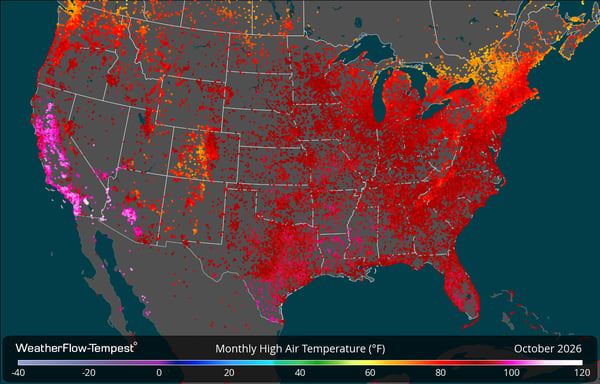
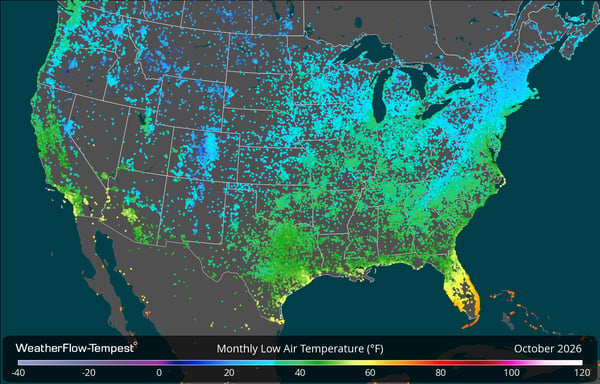
- What the Tempest network picked up: wherever you’re reading from, here’s how October looked across our U.S. stations. The month’s high came in at 112°F in Rancho Mirage, California, while La Pine, Oregon took the low at 7°F. A span of 105 degrees!
Data Lookback: Gusts From Hurricane Isaias
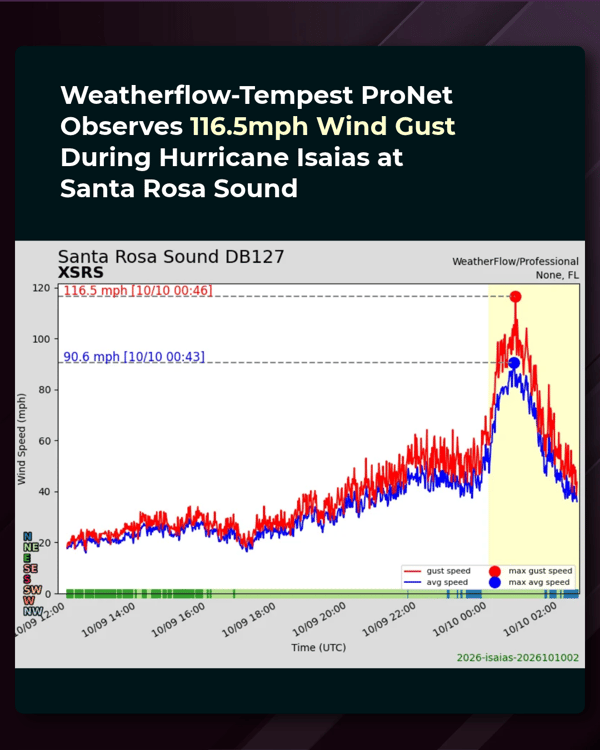
When Hurricane Isaias made landfall near Destin, Florida, on October 9th, it ended one of the quietest starts to an Atlantic hurricane season on record. Our Santa Rosa Sound station, part of Tempest’s ProNet network of professional-grade stations, reported a 116.5 mph wind gust along with 91 mph sustained winds during landfall. That was the highest observation the National Hurricane Center cited in its official landfall statement, meaning Tempest data became part of the official record of the storm as it happened.
This Month in Weather History
Most of us remember Thanksgiving weekend for the food, the family and maybe a football game. For millions of people across the eastern U.S. in 1950, it became the weekend of one of the most extreme winter storms the country had ever seen.
It started with an arctic cold front that swept through late on November 23 into the 24th, dropping temperatures from the 40s and 50s down into the teens. After the temperatures dropped, records began to fall next: Chicago hit -2°F, matching its all-time November low, and Louisville, Lexington and Bowling Green all set new record lows for the month the next day.
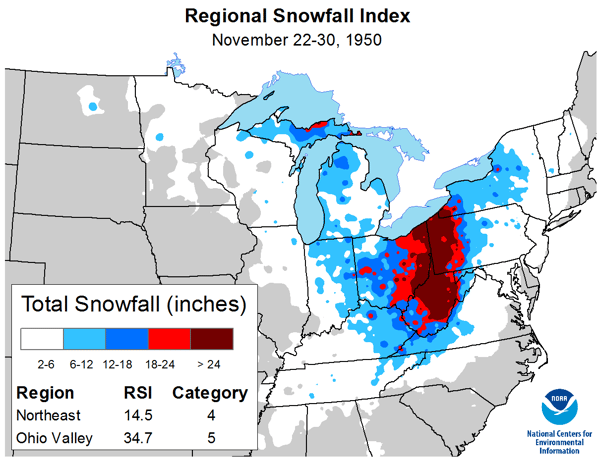
Low pressure developed over the Carolinas and tracked northwest into Ohio before stalling over Lake Erie for two days. By the end, parts of western Pennsylvania and West Virginia were buried under more than 30 inches of snow, with Coburn Creek, West Virginia, reaching 62 inches. Michigan and Ohio State even played through it in the now-famous “Snow Bowl.
One factor of the storm that would be later noted as unique was the contrast in conditions. Pittsburgh was snowbound with single-digit temperatures while Buffalo, about 200 miles north, sat in the 40s with no snow at all. Meanwhile, winds gusted to 108 mph in Newark and 160 mph on Mount Washington, and coastal flooding broke through dikes and swamped the runways at LaGuardia Airport.
The storm left 160 people dead, and insurers paid out more than for any storm or hurricane before it, a top spot still held today. On NOAA’s Regional Snowfall Index, it ranks as the worst of the 232 Ohio Valley storms analyzed. Seventy-six years later, it’s a reminder of how much the weather can change over just a few hundred miles.
Read more about the Great Appalachian Storm of 1950 from NOAA’s National Centers for Environmental Information and NWS Jackson, KY.
When Conditions Change Faster Than the Forecast
Does your workplace need to know how fast conditions are changing, not just what was forecast yesterday? Rapid intensification can turn a manageable tropical system into a major hurricane within a single day, and as Isaias showed, the strongest conditions don’t always show up where the forecast points. TempestOne gives emergency management, utility, and coastal operations teams critical, hyperlocal weather intelligence backed by a dense network of local observations, from real-time alerts to dashboards that show conditions as they shift, so decisions keep pace with what’s actually happening. Read more about the science of rapid intensification and why timing matters.
Tempest in the Elements
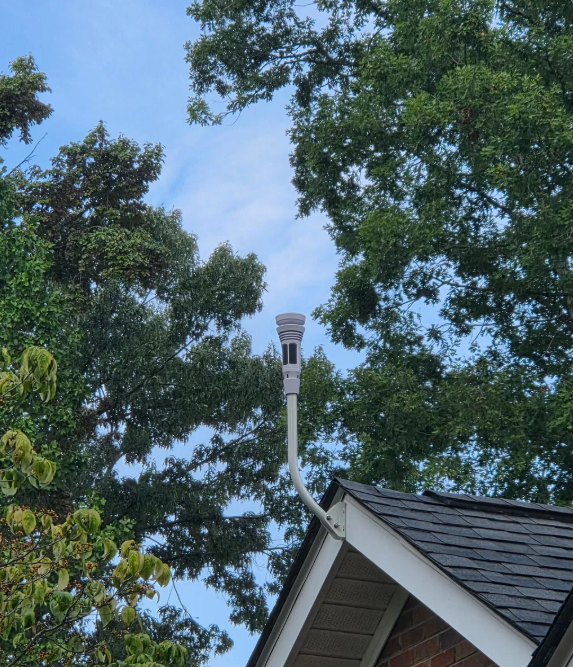
This month our Tempest in the Elements comes from Richard P. Thank you for sharing! Want your setup or project to be featured? Send us a photo of your Tempest setup (or include it in your review), your creative weather project, or other unique ways you’re using your station - or use the hashtag #tempestwx.
Other Weather News
Remembering Margaret Hamilton
Margaret Hamilton, the computing pioneer who led the team behind NASA’s Apollo flight software, died on September 30 at 90. She got her start in programming writing weather prediction software. She went on to help establish software engineering as its own field and to write the code that safely guided Apollo 11 to the moon. Read More >>>
Here’s How El Niño Could Shape Your Winter
Forecasters are calling for a warmer, wetter winter across the U.S. as a “Super El Niño” shifts weather patterns around the globe. What that means depends on where you live, from possible flooding along Pacific Northwest shorelines to a higher tornado risk in Florida. But a milder outlook doesn’t mean a snow-free season. As NOAA’s National Weather Service director put it, El Niño doesn’t erase the risk of winter snow. Read More >>>
When Is It Too Late to Plant in Fall?
Before the ground freezes, there may still be time to get a few more plants in. Using the "six week rule" is a good general standard, but how late you can plant depends on your USDA zone, your soil conditions and what you’re planting. Read More >>>
Back to: Newsletter, Articles